Annual vs Monthly Subscriptions: Save 15-40%
Annual plans save 15-40% on most subscriptions. Use this 3-question framework to decide when to switch and when to stay monthly.
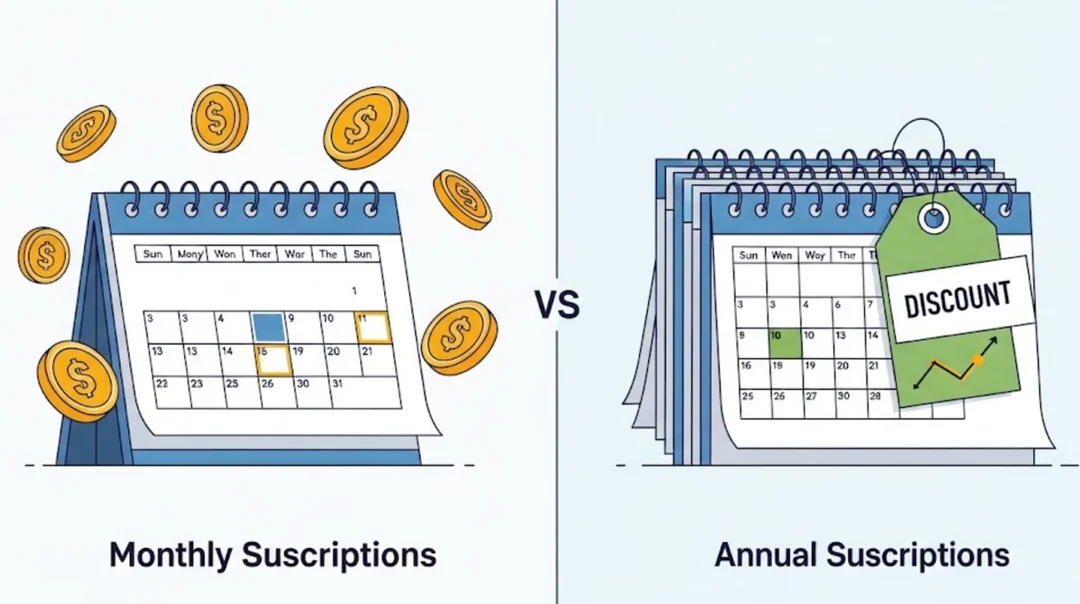
Most subscription services offer an annual plan at a discount. Spotify Premium costs $11.99/month or $119.99/year — saving you $23.89 annually. YouTube Premium runs $13.99/month or $139.99/year, a $27.89 difference. Adobe Creative Cloud charges $59.99/month or $659.88/year, which works out to $54.99/month and saves you $60 over twelve months.
The pattern is consistent. Annual plans save between 15% and 40% depending on the service. That sounds like a straightforward decision. It is not.
The Real Math on Annual Savings
Here is what the annual discount looks like across popular services:
| Service | Monthly | Annual (per mo) | You Save |
|---|---|---|---|
| Spotify Premium | $11.99/mo | $10.00/mo | $23.89/yr (17%) |
| YouTube Premium | $13.99/mo | $11.67/mo | $27.89/yr (17%) |
| Adobe Creative Cloud | $59.99/mo | $54.99/mo | $60.00/yr (8%) |
| Notion Plus | $12.00/mo | $8.00/mo | $48.00/yr (33%) |
| ChatGPT Plus | $20.00/mo | $16.67/mo | $40.00/yr (17%) |
| Todoist Pro | $5.00/mo | $4.00/mo | $12.00/yr (20%) |
If you paid annually for all six, you would save roughly $360 per year compared to monthly billing. Across a household with 8-12 active subscriptions, annual plans can easily save $400-600 per year.
Annual Savings by Service (vs. Monthly Billing)
Source: Service pricing pages, March 2026
But savings only materialize if you use the service for the full twelve months.
When Annual Plans Make Sense
Annual billing is the right choice when three conditions are true:
You use the service daily or weekly. Spotify, a cloud storage provider, a task manager you rely on for work — these are services woven into your routine. The chance of canceling mid-year is near zero.
You have been subscribed for at least three months. If you have already used a service through the honeymoon phase and still find it valuable, the pattern is likely to hold. Switching to annual at this point is a confident bet.
The price is stable or increasing. Many services raise prices annually. Locking in a yearly rate before a price increase gives you a double benefit: the annual discount plus protection from the hike.
If all three apply, switch to annual without hesitation.
Know exactly what you’re spending.
ReSubs shows your total subscription cost, tracks renewals, and alerts you before charges hit.


When Monthly Billing Is Better
Monthly plans cost more per month, but they buy you something annual plans do not: flexibility.
You are trying a new service. You signed up for a project management tool to see if it fits your workflow. Committing to twelve months on week two is a gamble. Pay monthly for at least two to three months before deciding.
Your usage is inconsistent. A meditation app you use three times in January and then forget about until April is not worth an annual commitment. If you cannot predict whether you will use the service next month, stay monthly.
Your financial situation is uncertain. An annual plan requires paying 10-12 months upfront. If cash flow is tight or unpredictable, the flexibility to cancel next month has real value that outweighs the per-month savings.
The service has a history of declining. If a platform has been cutting features, raising prices, or degrading quality, locking yourself into a year is risky. Monthly lets you leave when you need to.
- You use the service daily or weekly
- You have been subscribed for 3+ months
- The price is stable or increasing
- The upfront cost fits your budget comfortably
- You are trying a new service (under 3 months)
- Your usage is inconsistent or seasonal
- Cash flow is tight or unpredictable
- The service has been declining in quality
The Hidden Risk of Paying Annually
Here is the scenario most people do not think about: you pay $119.99 for a year of a service. Four months in, you stop using it. The remaining eight months — roughly $80 — is gone.
Most services do not offer prorated refunds on annual plans. Some do not offer any refund at all. Apple and Google handle this differently for app store subscriptions (Apple sometimes grants partial refunds on request; Google generally does not for annual plans), but direct-billed services almost universally keep your money.
This is the core trade-off. Annual billing saves 15-40% if you stay for the full year. But if you leave early, you often lose more than you saved.
A $120 annual plan that you cancel after five months costs you $10/month for the months you used it and $70 in wasted payments. If you had paid $11.99/month instead, five months would have cost $59.95 — less than half the annual price.
The discount only works if you finish the year.
Annual vs. Monthly Cost Over 12 Months ($120/yr vs. $11.99/mo)
Source: Based on Spotify Premium pricing ($11.99/mo vs. $119.99/yr)
A Simple Framework for Every Subscription
Before switching any subscription to annual, run it through these three questions:
1. How often did I use this in the last 90 days? Daily or weekly use = strong annual candidate. A few times a month = stay monthly. Less than that = consider canceling entirely.
2. How satisfied am I with the service on a scale of 1-5? A 4 or 5 means the service reliably delivers value. A 3 or below means something is off — stay monthly or cancel.
3. Can I afford the upfront cost without stress? If paying twelve months at once means skipping something else or dipping into savings, stay monthly. The 17% discount is not worth financial strain.
If a subscription scores well on all three — frequent use, high satisfaction, comfortable upfront cost — go annual. If it fails any one of the three, stay monthly.
12-Month Retention Rate by Billing Cycle
Source: RevenueCat State of Subscription Apps 2025
Tracking It All
The difference between saving $400/year and wasting $400/year often comes down to knowing your renewal dates. An annual plan you forgot about renews silently. A monthly plan you stopped using bills quietly for months.
ReSubs tracks every subscription's cost, billing cycle, and renewal date in one place. It sends reminders before renewals hit so you can make a deliberate choice — renew, switch plans, or cancel — instead of discovering the charge after the fact.
Track all your subscriptions in one place
Free on iOS and Android. No bank connection required.